
Juneteenth is a Reminder of Oregon’s Long Denial of Black Political Freedom
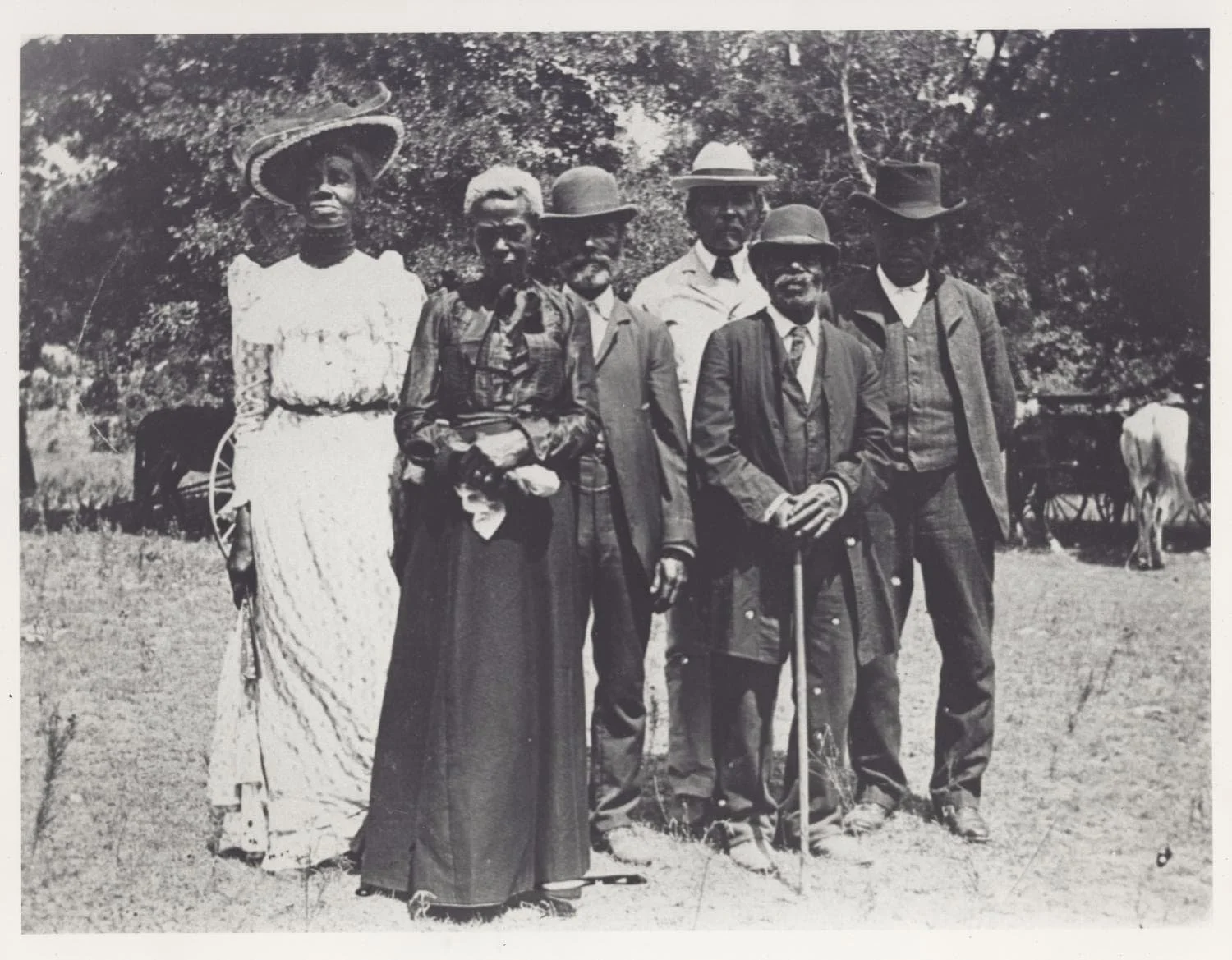
Juneteenth Emancipation Day Celebration, June 19, 1900, Texas. The Portal to Texas History Austin History Center, Austin Public Library.
Juneteenth marks the day in 1865 when enslaved Black people in Galveston, Texas finally learned they were free, more than two years after the Emancipation Proclamation had been signed.
The history of Black Americans in this country makes clear that freedom declared and freedom experienced are not always the same. Rights written into law are illusions until they become rights protected and enacted in practice. Nowhere is this more visible than in the long fight for voting rights that has again risen to the surface after the April 2026 SCOTUS decision on the Voting Rights Act.
The Voting Rights Act exists in response to discriminatory barriers to Black voting — in part because of the persistent racial turnout gap, the difference between white voter participation and participation among voters of color. That gap remains substantial nationwide. When participation is unequal, representation becomes unequal as well, and policy outcomes follow. Recent Voting Rights Act cases related to Section 2 have centered on whether Black communities can elect candidates of their choice. In states such as Alabama, Georgia, and Louisiana, courts ordered new congressional maps after finding that existing district lines diluted Black voting power. So, we have this question to ask, loud and clear: “Does representation in a state reflect the people who live there?”
Voting power influences who sits on school boards, county commissions, city councils, state legislatures, and courts. It affects housing policy, education funding, healthcare access, public safety decisions, transportation investments, and the distribution of resources. The question of who can participate and whose vote carries weight is ultimately a question about who has a voice in shaping the future.
For Black Americans, voting rights remain inseparable from the legacy of slavery and Reconstruction. After the Civil War, Black political participation surged. For the first time, Black communities were electing representatives, shaping policy, and exercising power at scale. In response, states and local governments developed new ways to restrict access to power. Voting barriers, discriminatory laws, intimidation, and violence were used to reduce Black political influence and limit participation in public life. While the methods have shifted over time, efforts to constrain Black political power have remained a recurring feature of American politics.
That history is often told as something that happened elsewhere — in the South, in a different era. But Oregon has its own record of exclusion to confront, including its founding as a “white utopia” after the Civil War. Oregon entered the Union in 1859 with Black exclusion laws written directly into its Constitution, prohibiting Black people from living, owning property, and entering into contracts in Oregon. Although the exclusion clause became unenforceable after the Civil War and the adoption of the 14th Amendment, Oregon voters chose to keep the language in the Constitution until 1926.
The 14th Amendment was created after the Civil War to guarantee citizenship and equal protection under the law for all people born in the United States, especially formerly enslaved Black Americans. Oregon initially ratified the amendment in 1866, but just two years later, Oregon became the only state to rescind its ratification of the 14th Amendment. It wasn’t re-ratified until 1973 with legislation introduced by Bill McCoy, the first African American elected to the Oregon Legislature.
Oregon also rejected the 15th Amendment, which protected Black men's voting rights, and did not ratify it until 1959. While those federal amendments applied regardless of Oregon's actions, the state's delayed ratifications reveal how reluctant Oregon was to embrace the expansion of Black citizenship and political participation.
Throughout the twentieth century, racist housing covenants and discriminatory lending practices limited where Black Oregonians could live and build wealth. In 1948, the NAACP successfully challenged these covenants in the Supreme Court case Shelley v. Kraemer. Courts could not enforce racially restrictive covenants through state action because they violated the Equal Protection Clause of the 14th Amendment. However, some discriminatory language remained embedded in property records long after it became unenforceable and it was only in 2023 when the state law simplified the process for homeowners to petition courts to remove discriminatory language from property records.
Even through this history, Oregon now benefits from protections that many communities spent generations fighting to secure — strong voting access with vote-by-mail and automatic voter registration that have made participation easier in many ways. Those are real gains that we fought for, but they do not mean the work is complete. Black Oregonians remain underrepresented in statewide and local offices. Disparities persist in access, outreach, and trust. And like every state, Oregon is affected by what happens at the federal level. When Black voters face barriers elsewhere, the consequences never stop at state lines. Congressional representation, federal policy, judicial appointments, and civil rights protections affect every state, including our own.
Fannie Lou Hamer, a leader in the fight for voting rights, said it plainly: “Nobody’s free until everybody’s free.” While this may feel like an inspirational slogan, it’s also an incisive explanation of how systems of freedom really work. If some communities are denied full participation, the system itself is distorted and we do not have full participation as a voting block. When voting rights are threatened, her statement is a practical truth that we can act on locally even when federal politics feel impenetrable.
The conditions that define freedom, including the right to vote, are shaped by what we do next and how willing we are to make sure everyone has those freedoms (even the ones we already enjoy in Oregon). If our policies and laws don’t take care of us, then we take care of each other and we change those policies and laws.
The NAACP has spent more than a century — and our branch has been part of that fight for 50 years — challenging voter suppression through litigation, public education, community organizing, and advocacy. The same combination of strategies remains necessary today. At the NAACP Eugene-Springfield branch, we believe the freedom we want looks like communities that can fully participate in the decisions that shape their lives. We’re working toward systems where access is not restricted by design or by neglect, and representation that reflects the people it serves.
At the NAACP Eugene-Springfield, we are working alongside our community towards a civil rights reclamation that includes;
Strengthening participation in Oregon elections.
Supporting Black voting rights nationally.
Providing voter education and civic learning opportunities.
Building relationships that increase participation and reduce isolation.
Creating spaces where people can learn, ask questions, and take action together.
Supporting youth leadership and civic engagement.
Partnering with community organizations working toward equitable representation and participation.
We are asking hard questions: Are we working to increase participation, especially among newer voters or those who have been left out? Are we organizing in relational ways to bring along the people who are closest to us first? Are we supporting the organizations working to defend voting rights nationally and locally?
Juneteenth is our reminder that progress can be difficult and repetitive. We know from our current reality that rights secured in one generation can be weakened in another if communities lose the capacity or willingness to defend them. Political memory helps us recognize familiar patterns when they reappear. We can shout our demands at the top of our lungs all day long. But we also have to understand that freedom is something that we build, protect, and expand together.
And sometimes, we have to do that hard work of reclaiming it together. Local action right here in our community is a place where civil rights reclamation can begin again.
Three Ways to Get Involved
Understand how voting rights affect representation, public policy, and community resources.
Become an NAACP member, attend a meeting, bring a friend, and participate in community conversations.
Support voter outreach, share accurate information, and help strengthen participation in your community.